



Advocacy for better understanding and acceptance of autism, especially non-speaking autism, is one of my passions; and the biggest motivation behind my work as a Steering Committee Member of the Institute of Neurodiversity, ION, Global. This is a role that has helped me meet other equally passionate autistics from across the world.
About a week ago, one of my colleagues, who leads the ION initiative in South Africa, got a request for help from the parent of a six-year-old Palestinian boy with non-speaking autism, living in a refugee tent in Gaza. The father, a former UNRWA teacher, used the only resource in his disposal- a smartphone, to reach out to a complete stranger for help.
Call it serendipity, or just destiny, that this request came my way. Language is never a barrier for people who truly wish to help. The person who reached out understands and speaks only Arabic, but we were able to use technology to translate his messages, and talk to him on zoom with a translator in tow. I was, on my network, able to find a therapist who is willing to train the parent to implement a low tech AAC Program for the child, besides finding a doctor to look at the child’s medical records and suggest the way forward.

War has a devastating human cost; and this cost is often borne by the most vulnerable of us humans. A thought that might occur is why communication and learning are goals when access to two meals a day and clean drinking water is a challenge. This thought brings me to the life and work of Dr Maria Montessori . A physician by profession, Dr Montessori
was assigned to work at a mental asylum during World War 1. There, Dr Montessori observed young children who were forced to stay by their mentally sick mother’s side showing signs of being developmentally delayed .
She strongly believed that the delays were a result of the environment that the children were growing in and the lack of stimulation thereof. This prompted Dr Montessori to create the ‘prepared environment’- a structured environment with scientifically designed materials that stimulate sensory learning. Sure enough, the children began to learn and grow better, and this experience became the foundation of Dr Montessori’s pivotal work in the space of child development.
Cut to the present day, when wars have put vulnerable young children at the risk of being reduced to a mere survivor statistic . I am an autistic person with sensory hypersensitivity, and there are days when the noise of the blender or the pressure cooker feels bothersome . I can’t even begin to imagine what the noise of bombardment and gunfire would do to a six year old autistic child.
My home and my room is the cocoon that I come back to, after dealing with the overwhelming sensory stimulation outside . What would life be like for a six year old who has been displaced from his home and forced to live in a tent? What would it be like for a six year old to experience such a trauma and not have a way to express anything?
Being able to express , not just one’s needs, but also thoughts, questions, fears, anxieties and insecurities is cathartic. Sorrow, loss and the burden of witnessing mindless violence is too heavy to carry, and it becomes enormously heavier when coupled with lack of expression. At the time of writing this piece , a kind therapist who I know has begun to train the parent online on implementing a low tech AAC for the boy ( as much as I wish, I have no way to send across a device loaded with AAC to a refugee camp in a war ravaged place), with the help of a translator. Granted, this is a very modest attempt in mountainous scheme of things, but hope, as they say is the foundation of human endeavour, and here’s me hoping that there is a way forward after all.
Avaz Megaphone is a platform for neurodivergent individuals to express themselves through the written word. We accept opinion pieces, short stories and poetry. Authors of accepted works will receive an honorarium. To make a submission please email us on: collaborate@avazapp.com
WRITTEN BY
Aditi Sowmyanarayan
Student & Writer
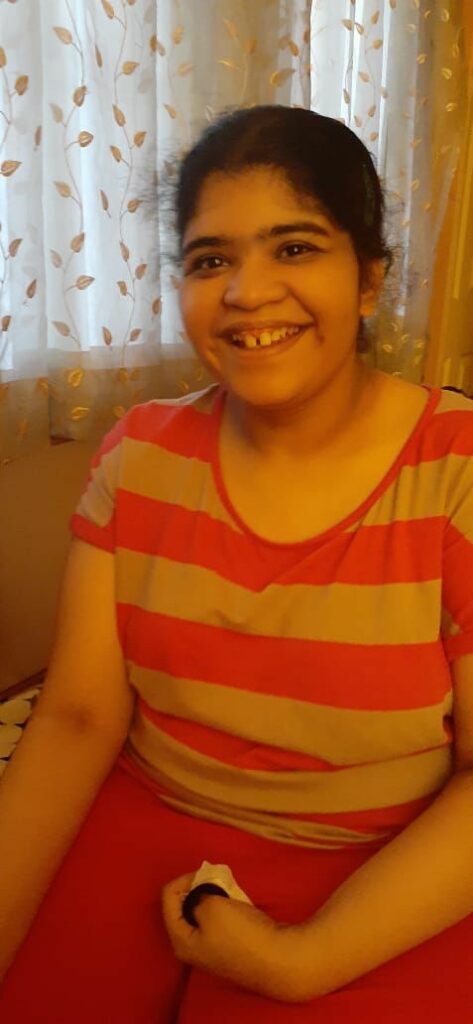
Aditi Sowmyanarayan is a nineteen year old who uses Avaz, a text to speech app, to communicate. She goes to Ishanya India Foundation, a special school in Bengaluru. Aditi is an avid blogger and an aspiring writer. She blogs on www.smallstepbigthought.blogspot.com
She can be reached on Instagram at writeaditi and on her Facebook page : small step big thought

As always, I love your blogs. it’s so pure and hard hitting. More power to you Aditi.
Thanks