


A familiar rhythm, a favorite song, or a playful pause in a melody can invite children to participate in ways that traditional language activities sometimes cannot.
Music offers a powerful pathway for AAC engagement in schools.
Not because it is therapeutic.
Not because it is entertaining.
But because music naturally invites communication.
A Moment in the Music Room
The class was dancing.
The teacher played a familiar song while students clapped and moved across the room. When the music suddenly stopped, everyone froze.
One student reached for their AAC device and selected:
“Go.”
The music started again.
A few seconds later, it stopped.
The same student tapped:
“Again.”
The room erupted in laughter. This was not a language drill.
This was not a prompted response.
It was participation. And participation is where communication thrives.
Why Music Works So Well for AAC
Music creates natural pauses, rhythms, and repetition. These elements make it easier for AAC users to anticipate language and participate.
Teachers often use familiar songs and pause just before a key word, inviting the AAC user to complete the line using their device¹.
For example:
A teacher might sing
“Because I’m…”
And pause.
The child selects “happy.”
Songs can also highlight specific core words. Playing songs that emphasize words like go or stop allows students to hear those words in meaningful contexts¹.
Even simple classroom games such as Red Light, Green Light can reinforce these words while combining music, movement, and AAC modeling¹.
These small shifts transform language learning from instruction into interaction.
Music Turns Vocabulary Into Action
Music activities provide natural opportunities to practice core vocabulary.
Words such as:
- go
- stop
- more
- again
- like
- happy
are already embedded in musical experiences.
Students can use their AAC devices to request songs, react to music, or comment on what they hear. For example, a child might say:
“More music.”
“I like this.”
“My turn.”
“Stop.”
These moments move AAC beyond requesting. They allow students to comment, share enjoyment, and interact socially.
Music also encourages turn-taking. When students sing together, play instruments, or participate in rhythm games, AAC users gain real opportunities to communicate with peers².
What Research Tells Us
Evidence suggests that music-based interventions significantly improve communication engagement in children with autism and other communication disorders³.
Researchers have documented increases in:
- communication initiations
- turn-taking
- joint attention
- social engagement
These gains occur because music creates a shared activity where communication naturally supports participation.
When AAC is embedded in these activities, students shift from passive responders to active communicators.
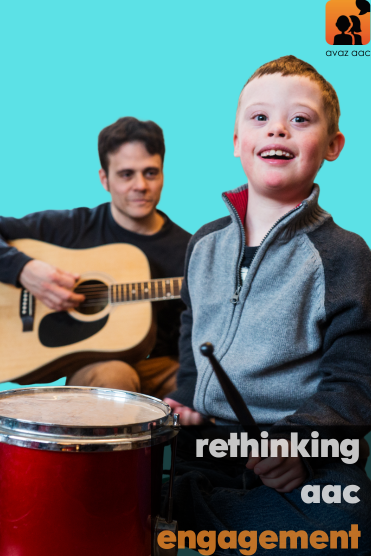
Instruments Create More Communication Opportunities
Instruments provide another layer of engagement.
Classrooms often use simple instruments such as drums, tambourines, keyboards, and shakers to involve students in musical activities².
Adaptive instruments expand these possibilities even further. Switch-adapted drums, bells, and keyboards allow children with physical challenges to participate fully in making music⁴.
These tools allow students to combine movement, sound, and communication.
A child might use their AAC device to say:
“Play drum.”
“My turn.”
“Loud!”
“Stop.”
Music becomes both the activity and the conversation.
Modeling AAC During Music
For music-based AAC learning to work well, adults play an important role.
One widely used strategy is aided language stimulation, where the teacher models AAC use during the activity without requiring a response⁵.
For example:
While playing a drum, the teacher might select “loud” on the AAC system.
While pausing the song, they might model “stop.”
This approach shows children how AAC fits naturally into communication.
Another useful strategy is slowing the activity. Pre-recorded songs can move quickly, leaving little time for AAC responses. Singing live or using instruments allows teachers to pause and give students time to respond¹.
Interest Leads to Engagement
Music is powerful partly because it connects with emotion and personal preference.
When educators use songs that children enjoy, engagement increases dramatically⁶.
A child who loves rhythm may eagerly participate in drumming. Another might respond to singing or dancing.
These preferences matter.
When AAC is embedded in activities children already enjoy, communication becomes meaningful rather than mechanical.
From Activity to Participation
Music classrooms often include:
- greeting songs
- transition songs
- rhythm games
- movement activities
These routines provide consistent opportunities to model AAC across the school day.
Over time, AAC becomes part of the environment rather than a separate task.
Students begin to use their devices to:
- choose songs
- comment on the music
- negotiate turns
- express emotions
Music becomes a platform for communication.
The Bigger Picture
Music reminds us that AAC engagement in schools does not come from devices alone.
It comes from environments that invite communication.
Robotics invites problem-solving.
Music invites expression.
Both create spaces where AAC users are not just responding to prompts. They are contributing, reacting, and participating.
And that is the real goal of AAC in schools.
Communication should not feel like a task.
It should feel like being part of the moment.
References
Anderson, S. (Talking With Tech Podcast). Teaching Core Words with Music.
https://www.talkingwithtech.org/episodes/shelley-anderson
PrAACtical AAC. Level 1 Week 2 Activity Sheets.
https://praacticalaac.org/wp-content/uploads/filebase/downloads/Level-1-Week-2-Activity-Sheets.pdf
Boster, J. et al. (2021). Communication outcomes in music therapy interventions.
https://theidfanatic.weebly.com/uploads/4/9/1/7/4917998/j.b.boster_et_al_2021.pdf
Enabling Devices. Adapted Musical Instruments for People with Disabilities.
https://enablingdevices.com/product-category/adapted-toys-games/adapted-musical-instruments/
AAC Language Lab. Teaching CoreScanner with Music.
https://aaclanguagelab.com/resources/teaching-corescanner-with-music
Australian Music Therapy Association. Music Therapy in Schools.
https://www.austmta.org.au/about/about-music-therapy/schools/