


What Happens When You Ask Us to Simplify AAC?
A peep into the conversations behind what we build.
Avaz was born in India. That matters.
India is not a mature AAC ecosystem. Awareness of AAC is still growing, access to trained professionals varies widely, and families often have to navigate technology, intervention and implementation themselves. Multiple languages and contexts coexist, and the systems around families don’t always provide the structure that exists in more established AAC markets.
That has shaped the way we build. It has also shaped the questions we ask.
But we don’t often get to pause our day-to-day work, pick a difficult question, look at evidence, argue asynchronously, and build on each other’s thinking. So we created Avaz Perspectives to do exactly that: a space where people across the company can bring their own experiences, challenge an idea, build on someone else’s perspective, and practise thinking together.
This isn’t a company position or a final answer. It’s a snapshot of a conversation while we’re still figuring things out.
For our first Avaz Perspective, we asked:
If an AAC system is difficult for families to implement consistently, should we simplify the system even if that means compromising some principles of ‘best practices’ in AAC?
We expected opinions. We got an argument.

Then someone challenged the argument, someone challenged the challenge, and eventually someone questioned whether we were even asking the right question.
And that’s exactly what we wanted.
At Avaz, disagreement isn’t the opposite of collaboration. It’s part of collaboration.
We don’t expect everyone building for the same problem to see it from the same angle. A salesperson, QA engineer, product person, marketer and someone working closely with AAC users will naturally notice different things.
The point isn’t to make everyone agree. The point is to make the question better.
How the thinking evolved
1. Maybe complexity isn’t the enemy
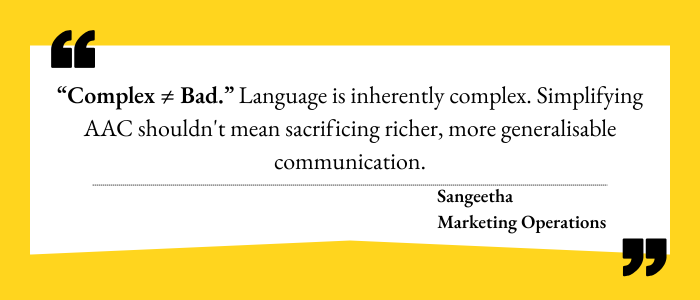
The first perspective pushed back on the premise itself. Google Maps is complicated because the world is complicated. AAC is similar because language is inherently complex. Simplifying it may improve short-term usability while sacrificing richer, more generalisable communication.
Complex ≠ Bad.
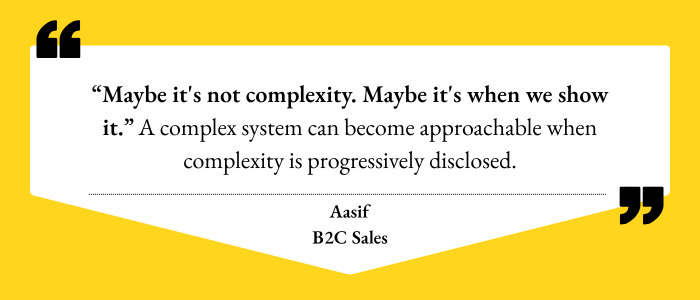
But another perspective challenged the Maps analogy. Maps doesn’t show every road at once. You see highways first and more detail as you zoom in.
The complexity hasn’t disappeared. It has been progressively disclosed.
And that matters when the person receiving an AAC device may already be overwhelmed by the technology, the intervention and everything else around them.
So perhaps the problem isn’t complexity.
Maybe it’s when we show it.
2. Maybe we should simplify implementation instead
This shifted the conversation from the AAC system to the people using it.
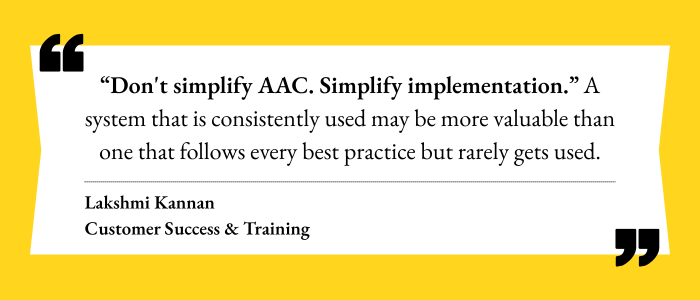
Instead of reducing the child’s access to language, perhaps we should make it easier for families to learn and implement AAC. Start with meaningful goals, model during everyday routines, and gradually build communication partner skills.
But that raised another question:
Should coaching be the thing that makes a product usable?
If families have to adapt to the product, perhaps we should ask whether the product could adapt more to families instead.
3. Then we started talking about habits
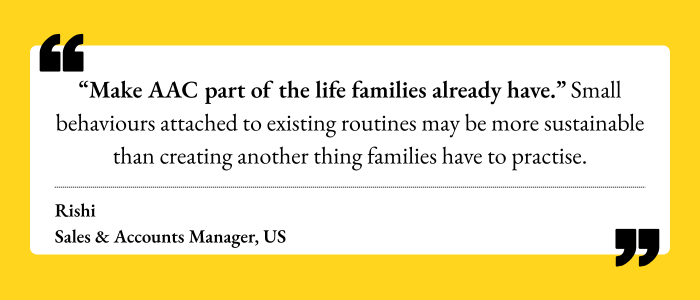
Families already have demanding routines. Asking them to create a separate “AAC practice” session can turn communication into another task.
Could AAC instead become part of routines that already exist?
Small, repeatable behaviours attached to everyday activities may be more sustainable than asking families to create entirely new routines. But there was a catch:
You can’t build a habit before someone starts.
If the first experience with the product is confusing or intimidating, there may never be a second experience. So perhaps there are two problems to solve: make the system easier to start with, then make it easier to build into everyday life.
4. What does “easier” actually mean?
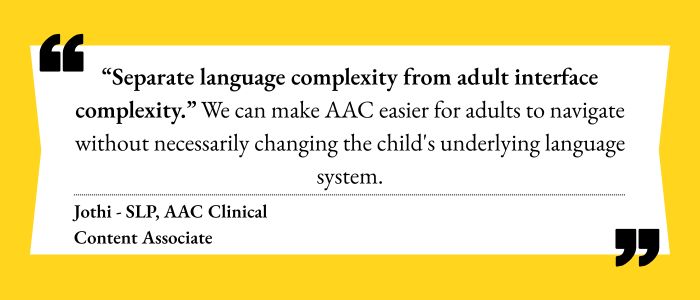
This is where the SLP perspective pushed back. Making AAC easier shouldn’t automatically mean making the grid smaller. Changing grid sizes can change the physical location of words and disrupt motor planning.
Perhaps we can instead separate language complexity from adult interface complexity.
Make the experience easier for the adult without necessarily changing the underlying language system for the communicator.
And before changing anything, QA brought another useful question:
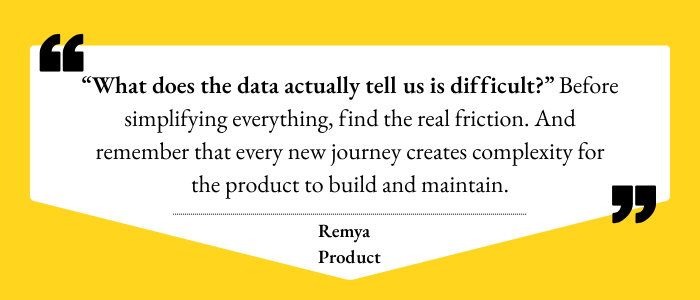
What does the data actually tell us is difficult?
Instead of simplifying the entire system based on assumptions, perhaps we should identify where the actual friction is. At the same time, every new user journey creates more things for the product to build, test and maintain.
So now we were asking not just whether something was easier for the user, but where the complexity moved when we made it easier.
5. What if support is part of the intervention?
The Low-Tech Board project gave us another way to think about this.
The ask was simple: make the boards visible in everyday spaces, touch the board and say the word once. The idea was to make AAC easier to weave into everyday interactions rather than create another task for families.
Having that structure around the parent made us think about support differently.
What if support isn’t something outside the product, but part of the intervention itself?
If the parent is the person enabling the child’s communication, supporting the parent may be just as important as designing the AAC system.
Which raises a different question: what kind of support does each family need, at what stage, and how can we make it scalable?
6. And then someone questioned the grid itself
At this point, the conversation got bigger.
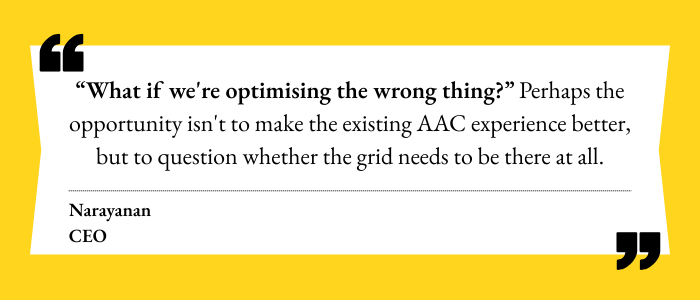
What if we were optimising the wrong thing altogether?
What if communication didn’t need a grid of pictures? What if we could design a completely new way of communicating?
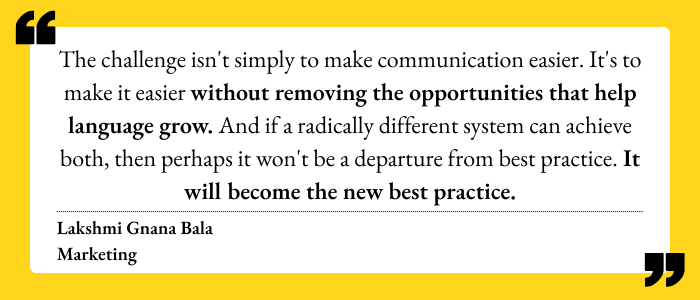
The analogy was provocative: taxis existed before Uber, hotels existed before Airbnb. Perhaps the opportunity isn’t always to make the existing experience slightly better, but to question assumptions the industry has taken for granted.
But AAC isn’t Uber.
AAC isn’t simply about accessing something that already exists. It is also about supporting the development and expression of language itself. So a radically simpler interface isn’t automatically better if it starts doing too much of the linguistic work for the communicator.
If a radically different system can make communication easier without compromising language development, perhaps it won’t be a departure from best practice. It will become the new best practice.
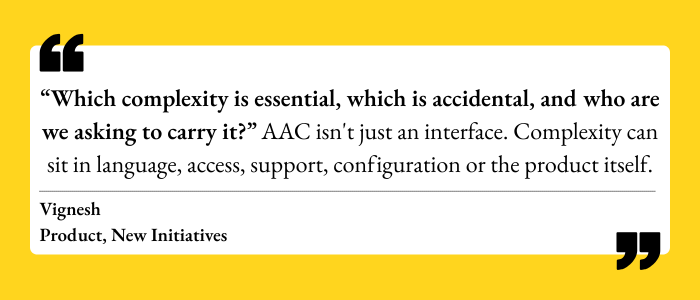
7. Which complexity are we actually trying to remove?
We ended this with a closing perspective that stepped back from the entire conversation and suggested that perhaps we were mixing several things together
An AAC system isn’t just an app. There is a language layer, interface layer, support and coaching layer, and access, configuration and setup layer.
And this brought us to Tesler’s Law: some complexity cannot simply disappear. It moves from one part of the system to another, or from one person to another.
So perhaps the question isn’t: Can we make AAC simple?
Perhaps it’s:
Which complexity is essential, which complexity is accidental, and who are we asking to carry it?
And if some complexity is accidental, why are we preserving it?
Meet the perspectives
The conversation took different turns because people came at the same question from very different places. Here are some of the perspectives that shaped it.
We didn’t reach a consensus.
And that’s the point.
We started by asking whether AAC should be simpler. We ended up asking where complexity lives, whether all of it is necessary, who carries it, and what happens when we move it from one part of the system to another.
That’s what we want Avaz Perspectives to capture. Not a polished company position, but the conversations behind the things we build. The different experiences, disciplines and ways of thinking that come together before we decide what to build next.
Because we build communication tools for people whose lives are already complicated enough.
So we’re going to keep asking uncomfortable questions about what we can make simpler, what we shouldn’t, and what we may need to rethink completely.
Now it’s your turn.
We’ve argued, challenged, built, and discovered that apparently even “make AAC simpler” is not a simple question.
What do you think? Which perspective would you challenge, build on, or take somewhere completely different?
Tell us in the comments. We want to hear your perspectives too.