


AAC is often introduced in schools as a communication tool. A device that helps a child request, answer, or participate during structured lessons.
But what happens when AAC moves beyond those predictable moments?
What happens when it shows up in robotics, storytelling, music, and creative play?
That is where real AAC engagement in schools begins.
A Moment That Changes the Room
It was supposed to be a simple STEM activity.
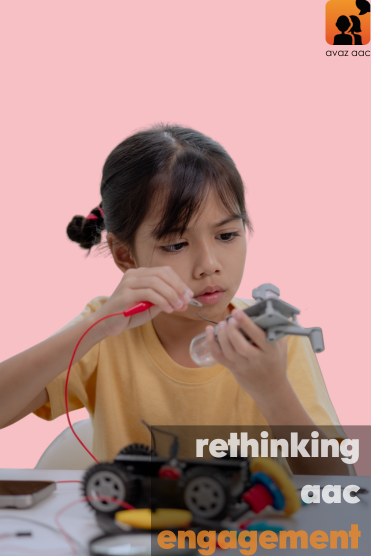
A small group of students sat on the floor around a wooden robot. The goal was to program it to move across a hand-drawn map of their classroom.
One student, an AAC user, had been quiet through most of the morning.
When the robot stopped short of its target, they reached for their device and selected:
“Go.”
“Again.”
“My turn.”
The room shifted.
This was not a prompted response.
It was not a therapy trial.
It was participation.
And that is the difference between using a device and engaging through communication.
AAC Is More Than Requesting
In many classrooms, AAC still appears mostly during:
- Circle time
- Therapy blocks
- Snack requests
- Question-and-answer sessions
These are important. But they are not enough.
Communication is not only about getting needs met. It is about sharing ideas, negotiating turns, expressing emotions, solving problems, and belonging to a group.
When AAC is limited to structured exchanges, we unintentionally limit the communicator.
Why Interest Changes Everything
Research on robotics and coding programs for neurodivergent children shows meaningful benefits.
A STEM intervention studying neurodiverse learners reported enhanced self-esteem, confidence, and emotional well-being after participation in robotics and coding activities¹.
A scoping review on educational robotics for students with autism similarly highlights how interest-based robotics programs can recognize strengths and build self-belief².
When children see their code work, the result is immediate and visible. That sense of control fosters agency. For many AAC users, that experience of agency is powerful.
Communication Grows Through Participation
Coding and robotics are not just about technical skills. They naturally create opportunities for language.
Educators report that robotics activities can be used to teach and model core words such as “go,” “stop,” and “turn,” while also motivating peer interaction³.
Teachers have also observed that students who typically struggle to communicate increased their language use during and after robotics sessions⁴.
Why?
Because the activity creates a real reason to communicate.
“Stop.”
“Wait.”
“My turn.”
“It didn’t work.”
“Let’s fix.”
Language becomes functional. It becomes meaningful. It becomes shared.
That is authentic communication.
Cognitive and Social Growth Go Hand in Hand
Beyond social interaction, coding activities have been shown to support cognitive development.
A study examining coding interventions for children with autism found improvements in attention, visual perception, and problem-solving skills⁵.
Inclusive classroom research further shows that computational thinking activities can strengthen collaborative play and social communication among neurodiverse preschoolers⁶.
These gains matter in school settings. When communication is embedded in thinking and collaboration, it becomes integrated rather than isolated.
Designing AAC for Real Classrooms
For this shift to work, the AAC system must support active, dynamic environments.
In robotics or storytelling sessions, students should not have to search endlessly for language. Predictable organization reduces cognitive load and supports motor planning.
Consistent vocabulary placement and access to core words across pages help communicators participate without interruption. When essential words remain available during coding or collaborative play, communication flows more naturally.
AAC works best when it adapts to the classroom, not when the classroom must pause for the device.
From Compliance to Contribution
There is an important difference between asking a child to “use your device” and asking, “What should we try next?”
The first focuses on compliance.
The second invites contribution.
Community coding programs for autistic adolescents have demonstrated how collaborative environments build confidence, identity, and social belonging⁷.
When AAC is embedded in such spaces, students are not simply responding to adult prompts. They are suggesting, revising, negotiating, and leading.
They are contributors.
Beyond STEM: A Broader Shift
Coding is one example. The principle extends much further.
AAC can be embedded into:
- Music sessions
- Art projects
- Science experiments
- Cooking activities
- Dramatic play
- Group storytelling
Wherever curiosity lives, communication can grow.
When we start with a child’s interests, engagement increases. When engagement increases, communication follows.
The Bigger Picture
If we want stronger AAC engagement in schools, we must move beyond device use as a standalone goal.
The goal is not simply more button presses.
The goal is participation.
Research consistently supports that playful robotics and coding environments enhance social interaction, language use, confidence, and cognitive development in neurodivergent learners¹²⁵⁶.
When AAC is woven into these meaningful activities, communication becomes purposeful and empowering.
Communication thrives where voices are needed.
And every classroom can be a place where those voices matter.
References
- Unlocking Potential: A Study on the Positive Impacts of Robotics and Coding Programs for Neurodiverse Children – Insights from an Educational Intervention. PUPIL: International Journal of Teaching, Education and Learning. https://grdspublishing.org/index.php/PUPIL/article/view/2682
- The Participation of Students with Autism in Educational Robotics: A Scoping Review. Social Sciences, MDPI. https://www.mdpi.com/2076-0760/12/12/675
- Using Robots & Coding to Teach Core Words and Support Peer Collaboration. Talking With Tech AAC Podcast. https://talkingwithtech.podbean.com/e/using-robots-coding-to-teach-core-words-and-support-peer-collaboration/
- Robots for Everyone and Especially For Those Learning Language Using Augmentative/Alternative Communication (AAC). Inclusive Design Blog. https://blogs.lcps.org/inclusivedesign/2021/09/10/%F0%9F%A4%96-robots-for-everyone-%F0%9F%A4%96/
- Coding Activities for Children with Autism: A Sample Application. Global Journal of Human Social Science. https://socialscienceresearch.org/index.php/GJHSS/article/download/103780/37995/53669
- Cultivating Computational Thinking and Social Play among Neurodiverse Preschoolers in Inclusive Classrooms. PMC. https://pmc.ncbi.nlm.nih.gov/articles/PMC12188882/
- ‘That connection with community… it is just a positive thing’: Mentoring autistic adolescents participating in community coding programmes. PMC. https://pmc.ncbi.nlm.nih.gov/articles/PMC11933780/